
Ten years ago, my life was transformed by a bullet journal.
My friend Meliors Simms is usually well ahead of me when it comes to trends. One day, she emailed: “I think you should know about this. Come over and I’ll show you.” That’s how I was introduced to the fascinating world of bullet journaling.
I’m not an early adopter, especially when it comes to planning and organising. Like many people, I carry too much in my head. I was taking copious notes, and the piles of paper under my desk were getting out of hand. I could see that keeping everything in one notebook might be a game-changer.
Bullet journalling for creatives as a metaskill
Taking charge of my organisational systems has become a practical act of personal power. I often have multiple creative projects on the go, and my bullet journal helps me co-ordinate time and energy. It’s improved my effectiveness—and reduced my stress.
Most planning apps and diaries force me into predefined categories that don’t reflect my real life. Bullet journaling is more than time management—it’s adaptable and deeply personal.
Not long after we started, Meliors invited me to contribute to a zine celebrating this low-tech, analogue metaskill for the 21st century. (By analogue, I mean it’s physical, 3-D, non-digital.) The next few paragraphs are drawn from that publication.
What is a bullet journal?
At its core, bullet journaling is a flexible system for turning a blank notebook into a combination diary, planner, and journal. Its great strength is adaptability—it can evolve to meet your changing needs.
Bullet journaling was developed by New York-based digital designer Ryder Carroll as an analogue complement to his online work. He released the system freely, with the stipulation that the name “bullet journal” not be used for profit. That’s why Meliors and I gave away our zine rather than selling it.
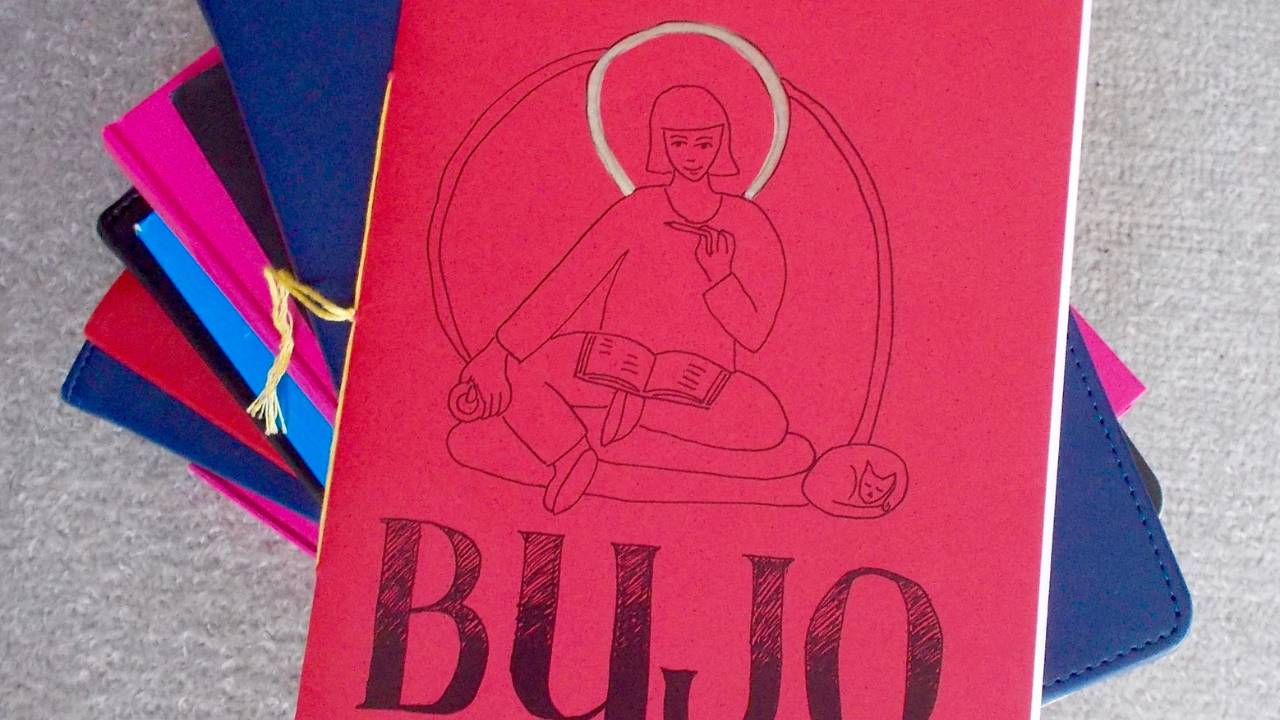
The BuJo zine: it’s a low-tech, analogue celebration of a low-tech, analogue metaskill.
Buddhist Journalling? Both practical and reflective
Bullet journal is often abbreviated to “BuJo,” but Meliors dubbed it “Buddhist Journalling”—a nod to the way it can integrate both “to-do” lists and more reflective, contemplative aspects of life.
The next two sections were my original contributions to the zine. Ten years later, they still hold true.
Magic bullet? Why I BuJo
BuJo isn’t just for organisational and systems junkies. It’s a metaskill that’s a huge asset to anyone who wants to be creative and playful without abdicating or outsourcing the practicalities of everyday life. We badly need this to help us navigate the complexity, chaos and challenges of our current world. And it also helps us get free of multitasking, which is a major energy drain.
BuJo encourages us to work out our own priorities and classification systems, rather than fitting our lives into a predetermined grid. This feels incredibly empowering. BuJo helps us get off the hamster wheel and into a place where we can make new things happen.
Integrating the Dreamtime
I’m a dreamer—and also a realist. My life was too complex to keep in my head, but with traditional diaries I was leaving out all the precious, half-formed ideas that didn’t fit into tidy categories.
After a year of time management, started off with some coaching from Meliors, I had an efficient calendar—but still thirteen bulging files of notes under my desk. The “urgent/important” grid didn’t capture the dreamtime, the ideas still in gestation. Many of them lived on scraps of paper, dated and filed—but often forgotten.
BuJo changed that. I now use one notebook for everything: plans, dreams, notes, reflections. It holds more of me than ever before. I feel more integrated, more visible—and more effective. It’s messy and physical, and that’s part of the magic. Nothing gets deleted by accident.
How to start bullet journalling
All you need is a blank notebook and a ballpoint pen. But there are many BuJo accessories, including felt pens, washi tape, stickers etc.
Because I was making such a huge change to my previous way of doing things, I found a couple of initial coaching sessions from Meliors very helpful. (She’s a great coach, by the way. Her website address is at the end of this post.)
Most of the BuJos on Pinterest and Instagram are beautiful and arty. But mine isn’t. Design and appearance aren’t my strong suits. My BuJo is full of messy notes and pages of scribble. I index and colour code topics and categories. This is made easy and fun for me by washi tape.
If you haven’t yet encountered washi tape, you’re in for a treat. It’s like decorative masking tape. It’s usually near the scrapbooking section of a stationery store.
The most important feature for me is to have everything indexed and all the pages numbered, so I can find things easily, and also look for patterns and connections.
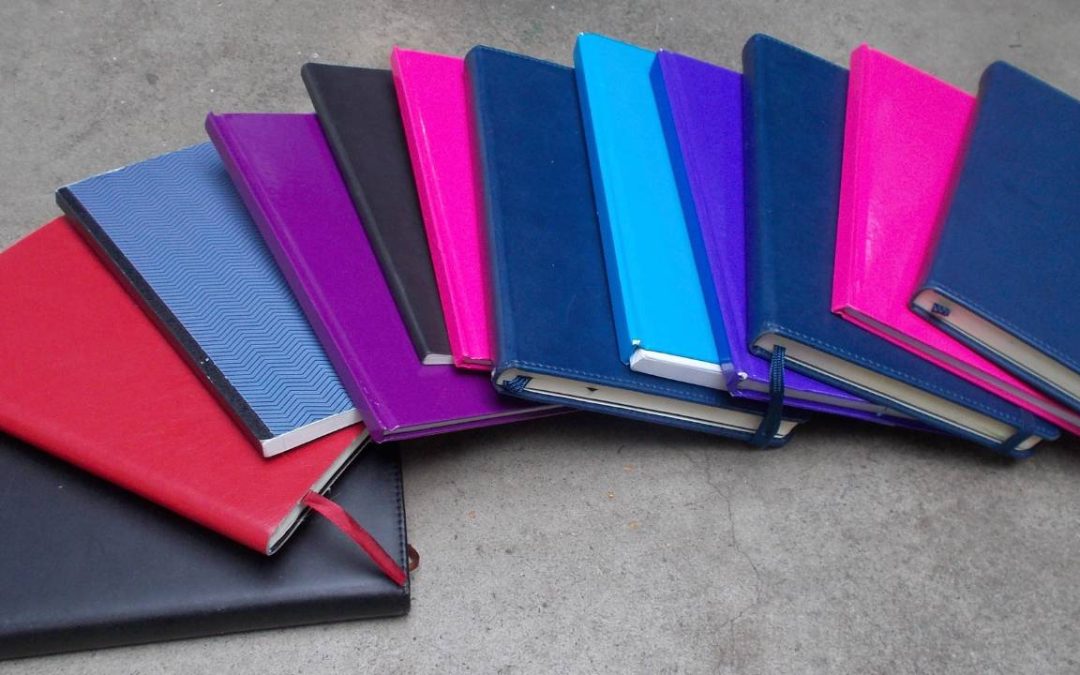
A5 bound notebooks are a good size for writing, while being small enough to carry in a bag. Spiral binding isn’t robust enough – the pages fall out. As the photo above shows, I use all kinds of notebooks. They usually cost less than $10 per book, but sometimes I run out of space and have to buy something more expensive. The “gold standard” notebook for BuJo is Leuchtturm, which is lovely, but too costly at my current rate of consumption. I get through approximately one BuJo per month. Most people probably don’t write as much as I do.
Below: A couple of the index pages from one of my BuJos: it’s not pretty, but the washi tape means I can find entries easily.
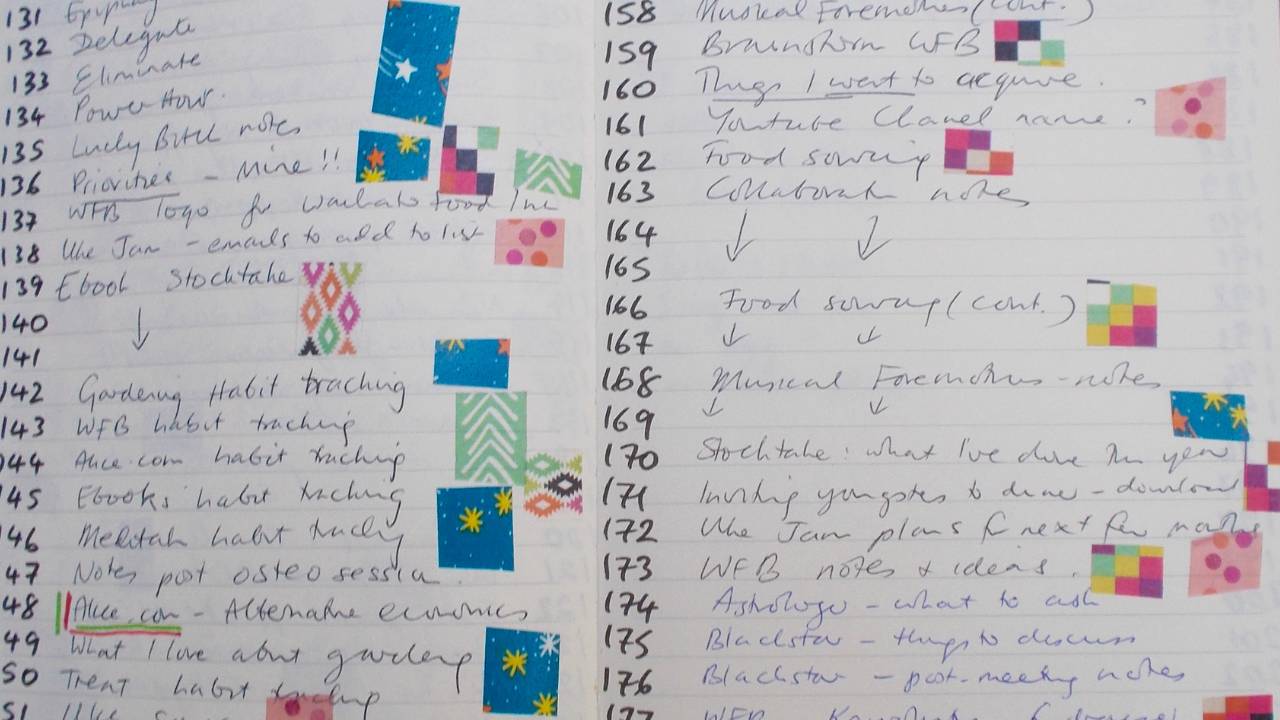
A couple of the index pages from one of my BuJos: it’s not pretty, but the washi tape means I can find entries easily.
What’s in my bullet journal
- To-do lists
- Notes and drafts (including ukulele projects)
- Article ideas
- Goal tracking
- Gardening and haircut logs
- Personal process notes
- Course notes
- Contact info
- Creative and dream content
More about bullet journalling
Ryder Carrol, the originator of bullet journalling: bulletjournal.com
Another interesting bullet journal blog: Tiny Ray of Sunshine
A shoutout
Meliors Simms is the Holistic Tooth Fairy, an international authority on alternative and holistic dental care. She’s the author of two award-winning books, The Secret Lives of Teeth, and Calm and Confident in the Dental Chair. You can find Meliors and her books at holistictoothfairy.com
Read more of my writing…
How to Start and Keep a Regular Spiritual Practice
Would you like to hear more from me?
Join my email list and I’ll send you a copy of my ebook, 12 Creativity Hacks for Musicians.
It’s full of my favourite tips for regaining your feeling of playfulness.
Here’s where you sign up: 12 Creativity Hacks for Musicians.